The science
This is the simplest version of the multiverse, the one Max Tegmark calls Level I. If space is infinite, and matter is spread through it the way we see it here, then any region the size of yours can only be arranged in a finite number of distinguishable ways (quantum physics caps the number of possible states). So in endless space every arrangement repeats, including an exact copy of you.
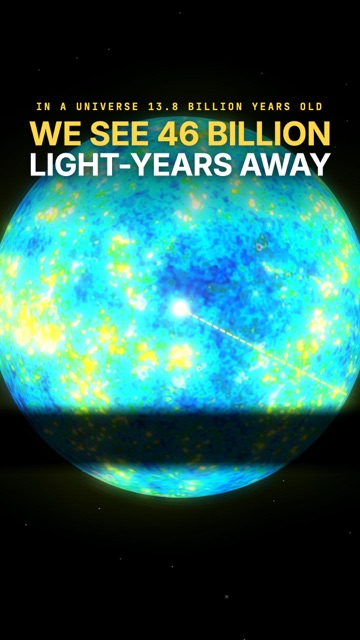
Tegmark (Scientific American, 2003) estimated your nearest identical twin is about 10^(10²⁸) meters away: a number with about ten billion billion billion digits. (His longer paper gives 10^(10²⁹).) The observable universe is only about 10²⁷ meters across, so we could never see that far.
Is space actually infinite? Nobody knows. Measurements of the cosmic microwave background (Planck, 2020) find space flat to within a fraction of a percent. That's what an infinite universe would look like, but a finite one could look the same if it's far bigger than the part we can see; a 2011 analysis (Vardanyan, Trotta and Silk) put a finite universe at no less than about 250 Hubble volumes.
The animation is a toy: tiles with three particles on a 3 x 3 grid have only 504 arrangements, so copies of yours turn up quickly. Real regions of space have unimaginably more.
Imagery: "The Blue Marble", Apollo 17, 1972 (NASA).
Sources
- Tegmark, M. (2003). Parallel universes. Scientific American 288(5), 40–51 (arXiv:astro-ph/0302131).
- Planck Collaboration (2020). Planck 2018 results VI: Cosmological parameters. Astronomy & Astrophysics 641, A6.
- Vardanyan, M., Trotta, R. & Silk, J. (2011). Applications of Bayesian model averaging to the curvature and size of the Universe. MNRAS Letters 413, L91 (arXiv:1101.5476).