The science
If space had no end and stars filled it, every line of sight would end on the surface of a star, and the whole night sky would blaze as bright as the Sun's disk. Kepler (1610), Halley (1721) and de Chéseaux (1744) wrestled with this before Heinrich Olbers made it famous in 1823; Hermann Bondi named it Olbers' paradox in 1952.
Distance doesn't help: a shell of stars twice as far away holds four times as many stars, each a quarter as bright, so every shell adds the same light.
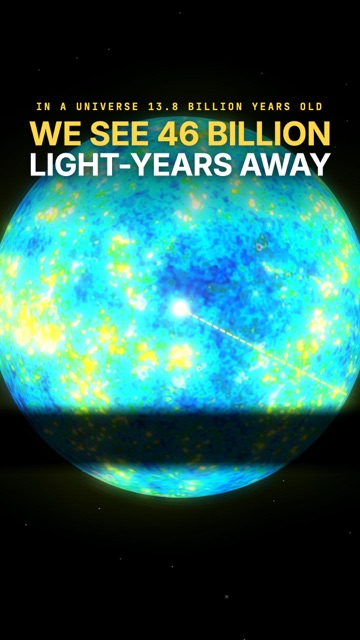
The answer is that the universe has a finite age, and stars don't shine forever. Light has had only about 14 billion years to travel, but you'd need to see roughly 10²³ light-years, about ten trillion times farther, before every sight line ended on a star (Edward Harrison, Darkness at Night). In 1848 Edgar Allan Poe suggested the dark gaps are there because light from the most distant stars hasn't "yet been able to reach us at all".
The twist: the sky does glow evenly in every direction. The cosmic microwave background was released about 380,000 years after the Big Bang, when the universe was about 3,000 kelvin, as hot as a cool star's surface. Expansion has stretched it into microwaves just 2.7 degrees above absolute zero.
Imagery: Milky Way panorama: ESO/S. Brunier (CC BY 4.0).
Sources
- Harrison, E. R. (1987). Darkness at Night: A Riddle of the Universe. Harvard University Press.
- Poe, E. A. (1848). Eureka: A Prose Poem. Putnam.
- Fixsen, D. J. (2009). The temperature of the cosmic microwave background. ApJ 707, 916.
- Planck Collaboration (2020). Planck 2018 results VI. A&A 641, A6.