The science
MoM-BH*-1 looks like one red star, but its light left about 13.1 billion years ago, when the universe was only about 660 million years old (redshift 7.76). An MIT-led team using the James Webb Space Telescope (Naidu et al., Nature, 2026) argues it isn't a star at all. They think it's a growing black hole wrapped in a cocoon of dense, churning gas tens of astronomical units across, roughly the size of our solar system (Neptune orbits at 30 AU). The gas is so thick that it glows like the surface of a star, about a hundred billion times brighter than the Sun, and it shows almost nothing but hydrogen and helium. No nuclear fusion could power it. They call it a "black hole star".
Webb has found hundreds of similar "little red dots" in its deep images, almost all from the universe's first billion and a half years. They might be what supermassive black holes look like while they are growing up, perhaps including Sagittarius A*, the black hole at the centre of our Milky Way (about 4 million times the Sun's mass). That last part is the discoverers' suggestion, not a result.
It isn't settled. Another peer-reviewed study (Nandal & Loeb, 2026) finds that a single metal-free supermassive star of about a million Suns fits the same light. Estimates of the black hole's mass span about a hundred times.
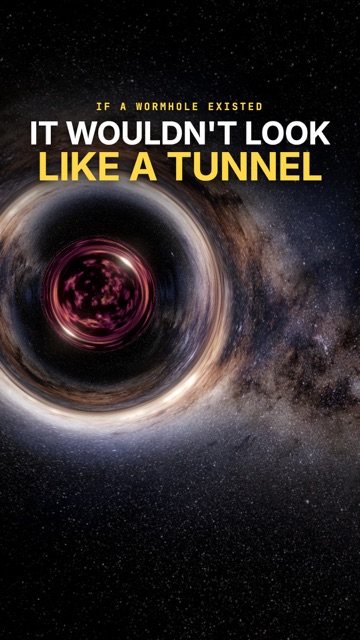
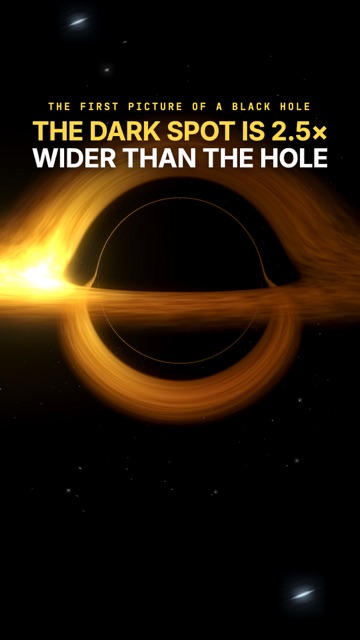
The see-through star, the view inside and the field of red dots are illustrations: the real cocoon is far too thick to see through. The light bending around the black hole is ray traced with general relativity, but the disk and the glowing gas are our drawing, and the red dots are placed by us, not mapped. The planets' orbits in the scale shot are to scale. At the end, the Milky Way is our own drawing, and its rewind to thirteen billion years ago illustrates the idea that our galaxy's black hole might have begun as one of these; it is not a simulation of how the galaxy formed.
Sources
- Naidu, R. P. et al. (2026). A gas-enshrouded and gas-reddened black hole at cosmic dawn. Nature 656, 329 (arXiv:2503.16596).
- Nandal, D. & Loeb, A. (2026). Astrophysical Journal (doi:10.3847/1538-4357/ae32f3): a supermassive star alternative.
- de Graaff, A. et al. (2025). Astronomy & Astrophysics (arXiv:2503.16600): The Cliff, a similar little red dot.
- Kokorev, V. et al. (2026). Astrophysical Journal; ESA/Webb release weic2610: GLIMPSE-17775.
- MIT News, 12 August 2026: "Astronomers discover a brand-new type of astrophysical object: A black hole star".
Images
- the tiny galaxies far away are ESA/Hubble and NASA pictures of nearby galaxies (CC BY 4.0), shrunk. The Webb picture of the little red dot GLIMPSE-17775 is NASA, ESA, CSA, V. Kokorev (University of Texas at Austin), A. Pagan (STScI) (CC BY 4.0).