The science
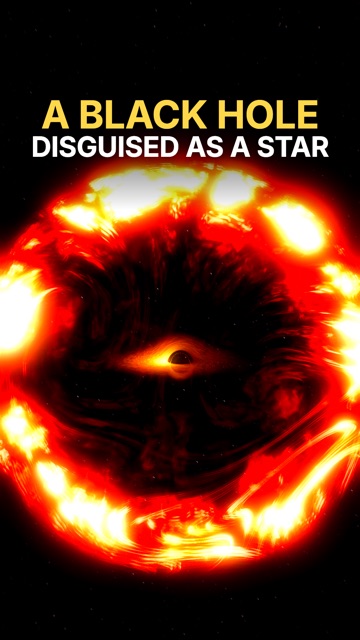
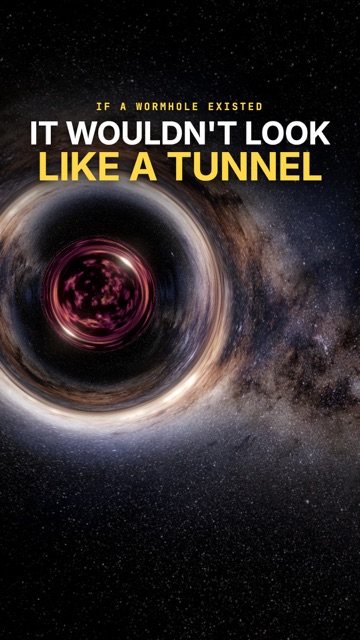
The dark centre of the first picture of a black hole, M87* (taken by the Event Horizon Telescope in April 2017, revealed in 2019), is the black hole's shadow, not the black hole itself. Gravity this strong bends light: light passing close enough spirals in, so from far away the dark patch looks about two and a half times wider than the event horizon. In ESO's words, the horizon "is around 2.5 times smaller than the shadow it casts." For a non-spinning black hole the ratio is 2.6; spin changes the shadow by only a few percent.
The bright ring is radio light, 1.3 millimetres long, from hot gas whirling around at nearly the speed of light, bent around the hole by its gravity. In the 2017 image the bottom of the ring is brighter because the gas there is swinging toward us, beaming its light our way. The orange is a colour map, not the gas's real colour.
M87* has about 6.5 billion times the Sun's mass and lies 55 million light-years away. Its event horizon is about 38 billion km across, about three times the width of Pluto's orbit. On our sky the ring is 42 millionths of an arcsecond wide: about the size of an orange on the Moon (our comparison). Seven radio telescopes at five sites saw it together, working as one Earth-sized virtual telescope; an eighth, at the South Pole, joined the campaign but can't see M87.
The shadow's size matched the prediction of Einstein's general relativity for the mass measured earlier from the galaxy's stars, to within about 17%.
The animation is a model: a non-spinning black hole, ray traced with a thin glowing disk, then a hot flow blurred to the EHT's sharpness. The light-path diagram is to scale.
Sources
- Event Horizon Telescope Collaboration (2019). First M87 Event Horizon Telescope Results I–VI. ApJ Letters 875, L1–L6.
- Psaltis et al. (2020). Physical Review Letters 125, 141104.
- Gebhardt et al. (2011). The Astrophysical Journal 729, 119.
- ESO press release eso1907 (10 April 2019).